
10.0.0.1 – 10.0.0.0.1 Admin Login – LBP Piso WiFi Router 2026
10.0.0.1 is a private class IP address that works as the default gateway for many popular routers think of it as the direct entry point into your router’s admin control panel, where every network setting lives. Brands like Xfinity, Comcast, and LPB Piso WiFi all use this address by default.
Once you know how to access it correctly through your browser’s address bar, managing your WiFi settings becomes straightforward. And if you need a quick reference for your specific router brand or default credential list, 10001loginph.com has everything covered in one place.
Looking for your router’s admin panel? You’re in the right place. Use the buttons below to open the 10.0.0.1 login page directly in your browser no searching needed.
⚠️ Note: 10.0.0.0.1 is a common typo the correct IP address is 10.0.0.1. Both buttons above take you to the same correct login page.
Default logins for 10.0.0.1
One mistake I made myself the first time typing 10.0.0.0.1 instead of 10.0.0.1. That one extra zero makes it an invalid IP address and the browser simply won’t open it.
The correct admin address is always 10.0.0.1, and once you get that right, your admin dashboard lets you change your WiFi name (SSID), update your password, set up a guest network, manage security settings, control connected devices, and handle piso wifi pause time for LPB Piso WiFi owners.
Disclaimer
This website is created for educational purposes only, and all content is originally written by Arif Khan nothing is copied from any source. We are not affiliated with any brand or company mentioned here. If you have any concerns, please contact us directly before taking any legal action.
What is 10.0.0.1?
Every router has a default IP address and for many popular brands, that address is 10.0.0.1. It is a private IP assigned by your ISP that acts as the gateway to your router’s admin panel.
From this one address, you can:
- Change your WiFi name (SSID) and password
- Block unwanted devices from your network
- Set up parental controls
- Update your router’s firmware
- Switch to faster DNS settings
- Adjust bandwidth and modem settings
- Monitor who is connected
You do not need advanced knowledge. Your router label has everything you need to get started, and you can also use a Free DNS Lookup Tool to verify your network details and ensure everything is configured correctly.
What is an IP Address?
An IP address is a number label given to every device on a network so data knows where to go. Think of it like a home address but for your phone, laptop, or smart TV.
The most common format is IPv4 four sets of numbers separated by dots, each between 0 and 255. This gives around 4.3 billion possible unique addresses.
There are four types you will come across:
| Type | How It Works |
|---|---|
| Public IP | Visible to websites and the internet |
| Private IP | Stays inside your home network (10.0.0.1 is one) |
| Static IP | Fixed never changes, used for servers and domains |
| Dynamic IP | Gets reassigned every time you connect |
When you connect to WiFi, your router gives your device a private IP. That address stays local only devices on the same network can see each other.
Router Brands That Use 10.0.0.1
Many popular brands use 10.0.0.1 as their factory default IP. Check your router label to confirm:
| Brand | Uses 10.0.0.1? |
|---|---|
| Cisco | ✅ Yes |
| Comcast/Xfinity | ✅ Yes |
| SMC | ✅ Yes |
| Technicolor | ✅ Yes |
| Arris | ✅ Yes |
| Aztech | ✅ Yes |
| D-Link | ✅ Some models |
| Intelbras | ✅ Yes |
| RFNet | ✅ Yes |
| i-connect | ✅ Yes |
If your brand is not listed, try 192.168.1.1 or 192.168.0.1 or check your router’s label or manual, especially if you are using a 3JTech router.
Default Login Credentials for 10.0.0.1
Before you log in, you need a username and password. These are printed on the back of your router. Here are the most common factory defaults all are case sensitive:
| Username | Password | How Common |
|---|---|---|
| admin | password | ~70% of routers |
| admin | admin | ~10% of routers |
| cusadmin | highspeed | ~10% of routers |
| Cisco | Cisco | Cisco routers |
| highspeed | cusadmin | ~5% of routers |
If none of these work, someone has changed the credentials. Do a factory reset to restore the originals details in the reset section below
How to Login to 10.0.0.1
Logging into your router is simpler than most people think. You just need to be connected to your network and have the right login credentials ready. Here’s how to do it, step by step.
Step 1: Connect your device
Make sure your PC, laptop, tablet, or smartphone is connected to the router either through WiFi or a LAN cable (Ethernet). Without a working network connection, the login page won’t load at all.
Step 2: Open your browser and type the IP address
Open any web browser Google Chrome, Mozilla Firefox, Safari, or Microsoft Edge all work fine. In the address bar, type:
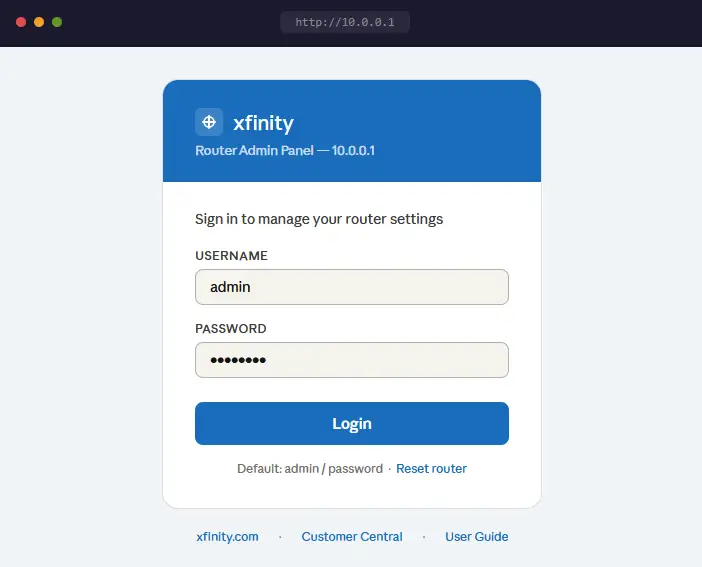
⚠️ If you see a security warning, try https://10.0.0.1 instead. Also make sure you haven’t typed 10.0.0.0.1 that extra zero is the most common reason the login window never opens.
Step 3: Enter your username and password
The login screen will show up with your router brand’s logo and two boxes: username and password. Enter your login credentials. For most Xfinity and Comcast routers, the default credentials are:
- Username: admin
- Password: password
Step 4: Access the admin dashboard
Once logged in, you’re inside the router’s control panel. From here you can:
- Do an SSID change or WiFi name update
- Do a password renew on your WiFi password
- Set up guest network options
- Apply a device limit and monitor connected devices
- Adjust 10.0.0.1 pause time for Piso WiFi sessions
- Manage internet access for your whole network
Quick Tip: The IP configuration range for routers on this address runs from 10.0.0.0 to 10.255.255.255. Some Xfinity or Comcast users change their login IP to something like 10.0.4.1 or 10.125.3.1 both work fine. If you forget a custom IP, a reset brings it back to default, and you can also perform an Uploading Speed Check to ensure your network settings are working properly.
How to Change Your WiFi Password
Changing your password regularly keeps your network safe and removes anyone who should not be on it.
D-Link‘
- Log in to the admin panel at 10.0.0.1
- Go to Wireless > Security Settings
- Find the Pre-Shared Key field
- Enter your new password, confirm, and save
Net Gear
- Log in and go to Wireless Settings
- Open Security (WPA2-PSK)
- Enter and confirm your new password
- Click Save and Apply
TP-Link
- Open browser and go to 192.168.0.1 or 192.168.1.1
- Go to Wireless > Security
- Update the password field, confirm, and apply
Password tip: Use uppercase, lowercase, numbers, and symbols together. Save it in your Notes app or Google account one forgotten password leads to a full factory reset, and you can also use a strong password generator to create a more secure and reliable password.
How to Change Your WiFi Name (SSID)
Your WiFi name is what shows up when people search for networks nearby. Here is how to update it:
- Log in to 10.0.0.1
- Go to Wireless Settings
- Click on the Network Name field
- Type your new name
- Click Apply
All your devices will disconnect and need to reconnect using the new name, especially if you are setting up a Guest Network/Guest SSID for separate access.
How to Block WiFi Users
If your internet is slower than usual, someone might be using your WiFi without permission. Here is how to find and block them:
TP-Link
- Log in and go to Advanced > Access Controls
- Open Online Devices
- Find the unknown device by name or address
- Click Block
D-Link
- Log in and go to Wireless > Advanced > ACL Setup
- Add MAC addresses of devices you want to allow
- Block everything else and save
Net Gear
- Go to www.routerlogin.net
- Open Advanced > Wireless Settings
- Set up an Access List
- Add allowed devices by name and apply
If unauthorized users keep coming back, enable your router’s firewall or set up a VPN for stronger protection.
Benefits of Using the 10.0.0.1 Admin Panel
Everything you need to manage your network lives in one place:
| What You Can Do | Benefit |
|---|---|
| Change WiFi name and password | Keep your network secure |
| Block unwanted users | Free up bandwidth and speed |
| Set parental controls | Restrict access for children |
| Update firmware | Get better performance and features |
| Switch DNS settings | Faster, more secure browsing |
| Enable WPA2/WPA3 | Stronger encryption |
| Set up VPN and firewall | Network-level protection |
| Adjust WiFi channel | Reduce interference from neighbors |
| Clear cache | Fix slowdowns quickly |
When to Use 10.0.0.1
You do not need to log in every day. But these are the situations where it is worth opening the admin panel:
| Situation | What to Do |
|---|---|
| Internet is slow | Block users, check bandwidth, clear cache |
| Forgot WiFi password | Reset router, use factory defaults |
| Unknown devices on network | Block via access control |
| Kids accessing bad content | Set up parental controls |
| Router needs update | Install firmware update |
| Poor signal in some rooms | Change WiFi channel |
| Need extra security | Set up VPN or firewall |
How to Reset Your Router
Use a reset when you have forgotten your password or the router is not working properly.
Steps:
- Find the small Reset button on the back of the router
- Use a needle, toothpick, or paperclip to press and hold it
- Hold for 10–15 seconds until the front light blinks
- Release the router restarts with all factory settings restored
- Log in using the default credentials from the router’s back label
If the router still acts up after resetting, unplug it for 30 seconds, then wait 2–3 minutes after plugging it back in before trying to log in again.
What is the Purpose of a Factory Reset?
A factory reset wipes your router completely and puts it back to how it was out of the box. Use it when:
What happens after a factory reset
Always save your credentials somewhere safe after setting up your router it saves you from going through a full reset later.
10.0.0.1 and Piso WiFi
Piso WiFi is a pay-per-use internet system popular in cafes, waiting areas, and public spaces. The 10.0.0.1 address is the control center for these setups.
Why 10.0.0.1 matters for Piso WiFi operators
- Set how long each session lasts
- Control bandwidth per user
- Monitor connected devices and data usage
- Accept coin or digital payments
- Display ads on the login page
- Schedule automatic router reboots
- Set up access restrictions
How to access Piso WiFi admin panel
- Connect your PC, phone, or laptop to the Piso WiFi network
- Open a browser and go to http://10.0.0.1
- Enter admin username and password
- Use the dashboard to manage all settings
How to configure Piso WiFi settings
| Setting | What It Does |
|---|---|
| Time Limits | Controls session length per user |
| Pricing / Payment | Sets coin or digital payment options |
| Bandwidth Control | Limits speed per user fairly |
| Security Features | Password protection, MAC filtering, firewall |
| User Activity Monitor | Tracks data and device connections |
| Scheduled Reboots | Auto-refreshes network at set times |
| Advertising Features | Shows ads on login page |
Advanced settings for better Piso WiFi performance
| Feature | Benefit |
|---|---|
| QoS (Quality of Service) | Prioritizes video and gaming traffic |
| Data limits per user | Stops heavy users from hogging bandwidth |
| Dual-band (2.4GHz + 5GHz) | Better speed and range |
| External antennas | Extends WiFi coverage area |
| Avoid interference | Keep router away from microwaves and cordless phones |
How to Reset Piso WiFi via Admin Panel
- Log in to 10.0.0.1 with admin credentials
- Go to System Tools or Maintenance
- Click Reset or Reboot
- Choose Factory Reset if a full wipe is needed
- Wait for restart, then reconfigure all settings
Common Issues/Troubleshooting/What If You Can’t Connect
Having trouble reaching your router at 10.0.0.1? Here are the most common problems and simple fixes for each one.
Admin Panel Loading Slow or not Opening at All
First thing to check is your device actually connected to the router? Not just showing WiFi signal, but properly connected with a stable connection. If WiFi keeps dropping, try switching to an Ethernet cable instead.
If you’re connected and the page still won’t open, the problem might be your browser:
- Clear your cache and cookies
- Close and reopen the browser
- Try a different browser or use a desktop browser instead of a mobile one
Incorrect IP or Invalid IP Address
Typing 10.0.0.0.1 instead of 10.0.0.1 is the most common mistake. That extra zero makes it an invalid IP the admin login panel won’t load and the browser won’t tell you exactly what went wrong. This also applies to 10.0.0.0.1 piso wifi users if you manage a Piso WiFi system and the 10.0.0.1 portal won’t open, always check the address first.
Also, not every router uses 10.0.0.1. Depending on your router model and brand, the default gateway might be 192.168.0.1 or 192.168.1.1. Run ipconfig on Windows or check system preferences on Mac to find your actual router IP.
VPN is Blocking Your Access
If you have a VPN running on your device, it reroutes your traffic in a way that blocks access to local router IPs. This creates a VPN conflict that looks like a basic connection problem. Turn your VPN off completely before trying to open the login portal.
10.0.0.1 Not Working on Mobile
If 10.0.0.1 is not opening on your phone, the fix is almost always one of these four things.
- Turn off mobile data first: This is the most common reason the page fails on a phone. When mobile data and WiFi are both active at the same time, your phone sends the local IP request through mobile data instead of your router and mobile data has no idea what 10.0.0.1 is. Go to your settings, turn mobile data off completely, stay on WiFi only, then try again.
- Make sure you are actually connected to the router: Your phone might show a WiFi signal but still not be properly connected to the network. Forget the network and reconnect, then open your browser and try 10.0.0.1 again.
- Type it in the address bar, not Google: On mobile especially, people accidentally type 10.0.0.1 into the search bar instead of the browser’s address bar. That sends you to a Google search, not your router. Tap the address bar at the top of Chrome, Firefox, or Safari and type http://10.0.0.1 directly there.
- Try a different mobile browser: Some mobile browsers block access to local IP addresses by default. If Chrome is not working, try Firefox or Safari. If you are on Android, also check that no VPN app is running in the background VPNs reroute local traffic and block router access the same way they do on desktop.
Mobile Data is Getting in the Way
When your phone is connected to both mobile data and WiFi at the same time, it sometimes sends local requests the wrong way. Turn mobile data off and stay on WiFi only when opening 10.0.0.1 from a mobile device.
Hardware Problem or Loose Connection
If nothing else works, check the physical setup:
- Make sure the connection cable is properly plugged in
- Look for loose wires or a faulty port
- Try a different cable or port
- Test from a different device to see if the problem is with your device or the router
Hardware that’s physically damaged won’t work no matter what IP address you try.
You Forgot Your Password
If your username or password isn’t working and you can’t recover it:
- Find the RESET button on the back of your router
- Use a pin or toothpick to press and hold it for 15 seconds (up to 15–30 seconds)
- Wait for the router to reboot
- Log in using the default credentials (usually admin/password)
After resetting, try 192.168.0.1 or 192.168.1.1 if 10.0.0.1 still doesn’t respond the router IP may have been changed before the reset.
Incorrect vs. Correct IP Address Formats for Router Login
A single typo in the address bar is enough to block you from your router completely. Here’s a table of the most common wrong formats people type and what they should be entering instead:
| ❌ Incorrect Format | ✅ Correct Format |
|---|---|
| 10.0.0.0.1 | 10.0.0.1 |
| 1.0.0.0.1 | 10.0.0.1 |
| 10.0.01 | 10.0.0.1 |
| http://10.0.0.0.1 | http://10.0.0.1 |
| http;//10.0.0.0.1 | http://10.0.0.1 |
| 10.0.0.0.0.1 login | 10.0.0.1 login |
| 10.0.0.0.1 login | 10.0.0.1 login |
| 10.0.0.0.1 admin | 10.0.0.1 admin |
Every entry on the left is invalid. Here’s why each one fails:
- 10.0.0.0.1 and 10.0.0.0.0.1: Too many number groups. A valid IPv4 address has exactly four sets, separated by dots. These have five or six.
- 1.0.0.0.1: Five groups again, and the first number is wrong.
- 10.0.01: A dot is missing between the third and fourth numbers.
- http;//10.0.0.0.1: The colon is replaced by a semicolon. The browser can’t read this address format at all.
These mistakes usually happen when people type quickly from memory. Always enter http://10.0.0.1 carefully and directly into your browser’s address bar. Typing it anywhere else simply won’t work.
Common Router Settings You Can Customize with 10.0.0.1
Most people open the settings portal at 10.0.0.1 once to change their WiFi password and never go back. But your admin panel gives you a lot more control than that here’s a clear look at what you can actually manage.
WiFi Name and Password
- Change your SSID to a distinctive network name that’s easy to spot
- Update your Wi-Fi name so it doesn’t look like every other default network nearby
- Set a strong password to keep your Wi-Fi protection solid
- These are the most basic Wi-Fi settings and should be updated right after your first login
Device Management
- See every connected device on your network your smart TV, gaming console, work laptop, phones, and everything else
- Block any unknown device as soon as it shows up
- Allow or deny devices using their MAC address
- Set a device limit to control how many devices can connect at once
Parental Controls and Internet Access Control
- Block websites or restrict adult content directly at the router level
- Set screen time limits for specific devices
- This works across all devices on your network perfect for families
QoS Bandwidth Prioritization
- Prioritize internet speed for specific devices (like your work laptop during video calls)
- While the gaming console or other devices run updates in the background, your priority device keeps its full speed
- All managed directly from the admin panel no extra tools needed
Security Configuration
- Set up firewall rules to control what network traffic can get through
- Block unwanted access at the router level
- Premium users with the right hardware can set up a VPN directly through 10.0.0.1
- Create a separate guest network so visitors don’t get into your main home network
Note: 10.0.0.0.1 does not open this settings portal. The only correct login address and valid IP address is 10.0.0.1 all Wi-Fi settings, network security, and internet access control are behind that one address.
Router Setup Differences Across Brands and How 10.0.0.1 Is Used
Not every router uses 10.0.0.1 as its default IP address. Some come set to 192.168.0.1 instead and assuming one works for all is a common router setup mistake that wastes a lot of time.
Both addresses belong to the IPv4 reserved private IP range a private address block used only for local network traffic that never goes out over the public internet. This private IP range is what makes it safe for routers to use these addresses across millions of homes and business networks without any conflict. A valid IPv4 address always has exactly four sets of numbers 10.0.0.0.1 with five groups is mistyped and invalid, plain and simple.
What Happens After I Change the IP Address?
When you save a new IP address inside the admin panel, a few things happen immediately that catch people off guard if they are not expecting them.
The router reboots automatically. This is normal the new IP does not take effect until the device restarts. During that reboot, your WiFi connection drops for 30 to 60 seconds. Do not panic and do not press the reset button. Just wait.
Once the router comes back online, 10.0.0.1 will no longer open the admin panel. Your new custom IP whatever you set, like 10.10.10.1 is now the login address. Type that into your browser’s address bar going forward.
Your devices reconnect automatically in most cases, but you may need to forget and rejoin the WiFi network on some devices before they pick up the new gateway correctly. If a device cannot connect after the change, go into its network settings, forget the network, and reconnect.
If you forget what IP you set, do not guess. Run ipconfig on Windows or route -n get default on Mac the Default Gateway value shows your current router IP. On Android or iPhone, tap your connected network and check the gateway field.
And if everything stops working entirely, a factory reset brings the router back to 10.0.0.1 and wipes the custom IP along with everything else.
What’s Different Across Router Brands
- The admin dashboard, menus, and setting names all look different depending on the router model and manufacturer
- A Cisco business router panel looks very different from a home router even if both use the same login IP and admin login steps
- Business networks on enterprise hardware have deeper IP configuration options compared to regular home routers
- But the login method typing the default IP address into the browser is the same no matter the brand
IP Customization After Login
Once you’re inside through 10.0.0.1, you can change the default IP to a custom IP address you prefer like 10.10.10.1, which is easy to remember. Setting it as a static IP keeps it saved after restarts.
If you forget what custom IP address you set, a factory reset clears everything and returns the router to its router default giving you a clean start for your local network and IP configuration, no matter the brand or router model.
Easy Steps to Set Up Xfinity and Comcast Routers Using 10.0.0.1
Setting up a Xfinity or Comcast router through 10.0.0.1 is really two jobs: the admin panel settings, and the physical router placement. Most people spend all their time on settings and ignore placement and then wonder why their internet speed and connection stability aren’t consistent.
Step 1: Place Your Router in the Right Spot
Where you put your router matters more than most settings:
- Put your ISP router on a shelf or wall, raised above the floor
- Keep it away from thick walls that block signal
- Move it away from things like cordless phones and microwave ovens these create interference in the 2.4 GHz band that no setting can fix
- Place it in the middle of your home for even signal strength everywhere
Step 2: Pick the Right Wireless Channel
Channel selection is especially important in busy areas:
- In apartment buildings and other crowded areas, the 2.4 GHz band gets congested quickly
- Use channels 1, 6, or 11 these are the only non-overlapping options in the 2.4 GHz range
- Use the 5 GHz band for devices close to the router it gives fast internet speeds and has many more available channels
- Check channel congestion from the wireless setup section inside your admin panel
Step 3: Log into the Admin Panel at 10.0.0.1 and Set things up
Once your router is in place and connected:
- Log in at 10.0.0.1 with your username and password
- Change your default login right away this is the most important admin security step
- A strong password keeps unauthorized access away from your home network
- Go through the wireless setup and choose the right frequency and channel selection
- Make sure your router is compatible with your ISP’s requirements
- Check for a firmware update if one is available it improves network optimization and stability
A well-placed router with the right router configuration and channel selection will always perform better than one with great settings but poor positioning.
LPB Piso WiFi Using 10.0.0.1
LPB Piso WiFi also known as Lintech Piso WiFi Box is a popular piso wifi vendo system built for public areas across the Philippines. If you’ve been to a sari-sari store, a waiting terminal, or a small community spot, you’ve probably seen one. The idea is simple: a user puts a coin (usually 1 peso) into the coin slot machine attached to the unit, gets a set amount of time on the local wireless network, and the internet timer counts down in real-time. It’s one of the most widely used piso wifi 10.0.0.1 systems in the country, and every part of it is managed through the 10.0.0.1 portal.
For Owners: Managing Through 10.0.0.1
The whole WiFi business Philippines operation runs through the admin panel at piso wifi 10.0.0.1 not the invalid 10.0.0.0.1 piso wifi address that some people mistakenly type. Logging in at lpb piso wifi 10.0.0.1 gives owners access to:
- Pricing controls and time limits for sessions
- Login portal customization
- WiFi access control settings
- Monitoring features that track all active sessions in real-time
- A voucher code generator for prepaid access codes an alternative to the coin slot machine that makes the system more flexible
For a detailed setup walkthrough specific to LPB hardware, 10001loginph.com covers the full lpb piso wifi 10.0.0.1 admin process with step-by-step instructions.
For Users: The WiFi Pause Feature
One great feature of piso wifi 10.0.0.1 is the piso wifi pause time option. If your session gets interrupted:
- Go to the 10.0.0.1 portal
- Use the 10.0.0.1 piso wifi pause feature the internet timer saves your remaining time
- Come back later and pick up right where you left off
The 10.0.0.1 pause time system is what makes piso wifi vendo more user-friendly than a basic internet booth. The WiFi timer holds your piso wifi pause time 10.0.0.1 balance your coins aren’t wasted when something comes up mid-session.
The mix of internet vending hardware, WiFi management, live monitoring features, and a voucher code generator makes the Lintech Piso WiFi system a full internet business platform not just a WiFi vending machine. It’s one of the most used internet timer systems for public WiFi in the Philippines, and everything runs through 10.0.0.1.
The 10.0.0.1 IP Address
10.0.0.1 works so well as a local network address because of where it sits in the IPv4 address structure. It belongs to the 24-bit block of private IP addresses a private address block set aside specifically for local area networks (LAN). These addresses are never sent over the public internet on purpose. That’s what makes them safe for routers to use privately, across millions of homes and businesses, without clashing with public IPs.
Why Private IPs Matter the Bigger Picture:
The IPv4 communications protocol the core protocol behind standards-based internetworking and all modern internet routing supports around 4 billion unique IP addresses in total. That number ran out faster than expected. On 15 April 2011, the last regional Internet Registry used up its supply of freely allocated IPv4 addresses. That was the day the IPv4 exhaustion and IP depletion problem became official.
Since then, network administrators, ISPs, and internet providers have used NAT (Network Address Translation) to keep things going. NAT works by remapping one IP address space into another letting one public IP support many private devices. Private IP addresses like 10.0.0.1 act as substitutes for scarce public IPs, making IP reuse possible on a huge scale. This is what has kept internet architecture working well past the IP allocation problem and is still the main way the IP depletion issue is managed today.
In simple terms: your ISP gives your router one public IP. Your router then handles your whole LAN privately through the IP range, using 10.0.0.1 as the local gateway. The protocol takes care of everything else in the background no single device needs its own public IP, and your internet traffic works normally.
The long-term fix is IPv6
Internet Protocol Version 6 (IPv6) the successor to IPv4 expands the address space so much that running out becomes basically impossible. But moving from IPv4 to IPv6 takes many years. Right now, only about 25 percent of global internet traffic travels over IPv6. The IPv4 communications protocol still dominates, and private address blocks like the one containing 10.0.0.1 will stay as the main foundation of LAN access for a long time.
IPv6 — The Future of IP Addresses
Here is the short version of something the technical world has been dealing with for years.
IPv4 — the system that gives us addresses like 10.0.0.1 can only produce around 4 billion unique addresses. That sounds like a lot until you count every phone, laptop, smart TV, security camera, and IoT device connected to the internet today. The address pool ran out at the registry level back in 2011, and since then, a workaround called NAT (Network Address Translation) has kept things running. NAT lets your router share one public IP address across every device in your home your laptop, your phone, your smart TV all hiding behind that single address your ISP gives you. Private IPs like 10.0.0.1 are what make this possible at the local level.
IPv6 is the long-term fix. It uses a completely different address format and supports so many unique addresses that running out is effectively impossible. The transition has been happening gradually about 40 to 45 percent of global internet traffic now travels over IPv6 but the full switch takes time. Most home routers, ISPs, and websites still rely on IPv4 infrastructure, and private address blocks like the one containing 10.0.0.1 will remain the standard for local network access for the foreseeable future.
For everyday router use, none of this changes anything. Your admin panel is still at 10.0.0.1, your network still works the same way, and IPv6 runs quietly in the background where your ISP and router handle it automatically.
Placement
| Section | Kahan add karo |
|---|---|
| 10.0.0.1 Not Working on Mobile | Troubleshooting section ke andar VPN issue ke baad |
| What Happens After I Change the IP Address? | Router Setup Differences section ke baad |
| IPv6 The Future of IP Addresses | “The 10.0.0.1 IP Address” section ke baad purana replace karo |
When to Use the 10.0.0.1 IP Address
10.0.0.1 isn’t the default for every router it’s the router default for a specific group of broadband router and business router hardware. Other devices use 192.168.0.1 or 192.168.1.1 as their default, so knowing when 10.0.0.1 applies saves you a lot of guesswork.
When it does apply, there are three main reasons you’d use it:
1. Port Forwarding and Port Management
When a service needs to receive traffic from outside your network a gaming server, a remote desktop tool, or a self-hosted app you set up port forwarding through the 10.0.0.1 admin access panel. You pick the port or port range and point it at the primary device that should get those messages. Without this, any service that needs incoming connections simply won’t work from behind your router.
2. Firewall Configuration
The firewall in your router admin panel controls what network traffic is allowed in and out. Blocking specific ports, limiting access to certain services, setting traffic rules for each network device it’s all done from 10.0.0.1. This applies to both a business router managing many network devices and a home setup with just a few home devices on a LAN.
3. General Configuration and Network Management
Any change to how your broadband router works starts here:
- IP configuration changes
- Connected device management
- Bandwidth controls
- Access schedules
- All standard network management tasks
Administrators running large business networks often prefer 10.0.0.1 because it’s clean, easy to remember, and works well across a LAN with lots of network devices. For regular home devices, it does the same job at a smaller scale.
IP Address Conflict
Having two routers on the same home network is more common than most guides cover a main router plus a second one for extra coverage, or a mesh node added later. When both devices end up with the same IP address, the IP conflict that follows creates problems that feel random but are totally predictable.
What actually happens
You type 10.0.0.1 and try to log on to your main router’s admin panel. The browser either opens the second device’s page instead, or returns a webpage unavailable error. Neither router can reliably respond to the same address, and the network error shows up at random sometimes one device answers, sometimes neither does.
How to fix it
An administrator needs to give one of the devices a static IP address so they stop fighting over the same one. A clean way to do it:
- Keep 10.0.0.1 for the main router
- Change the second device to 10.0.0.2 or a different subnet
- This removes the address overlap and solves the device conflict at the source
Before making any IP assignment change, check each router’s current address through your network settings. A mistype during the fix assigning a wrong or duplicate address just creates a new router conflict. Write down every IP assignment before and after, test after each change, and make sure the home network is running well. If things get worse, a factory reset clears any router setup issue and returns each device’s default settings and IP configuration to a clean starting point.
Manufacturers Using 10.0.0.1 IP Address
The list of router brands that use 10.0.0.1 as their default IP address covers home routers, enterprise business networks, ISP-supplied hardware, and public WiFi systems.
Enterprise and Business Router Brands
These router manufacturers are commonly used in managed business networks and large ISP setups:
- Cisco: well-known business router and cable router hardware
- Arris: a common ISP router used in broadband setups
- Technicolor: widely used through ISP partnerships
- SMC: business-focused broadband router brand
- Aztech: used in regional business and DSL router setups
- Intelbras: Latin American market, handles a large number of devices
- i-connect and RF Net (RFNet): serve regional network markets
Home Router and ISP Router Brands
These cover the home router side using 10.0.0.1:
- Xfinity: one of the most well-known brands using this address
- Rogers, Shaw, Videotron: major North American ISP router brands
- Inteno: widely used in Europe as a home router brand
- Wi Fi5 Soft: used in some regional setups
- Claro: Latin American ISP deployments
Piso WiFi and Philippines-Specific Brands
- LPB Piso Wifi: Lintech’s piso wifi vendo system
- Ado Piso Wifi: another popular Piso WiFi router manufacturer
- I Connect: Philippines internet access hardware
If your device isn’t on this list and 10.0.0.1 isn’t working, the default IP address for your router brand and router model may be different. Check the sticker on the back manufacturers always print the exact default IP and login details there. You can also look up any brand quickly at 10001loginph.com.
FAQs About 10.0.0.1

Arif Khan 

Hi, I'm Arif Khan, a qualified Engineer with over 6 years of experience working with router and networking companies across the Philippines. I created 10001loginph.com to help everyday users navigate online platforms with ease and confidence. Alongside my engineering background, I'm also a passionate SEO Expert and Content Writer dedicated to delivering accurate, simple, and reliable digital guides. My goal is simple to make the internet easier for everyone, one guide at a time!